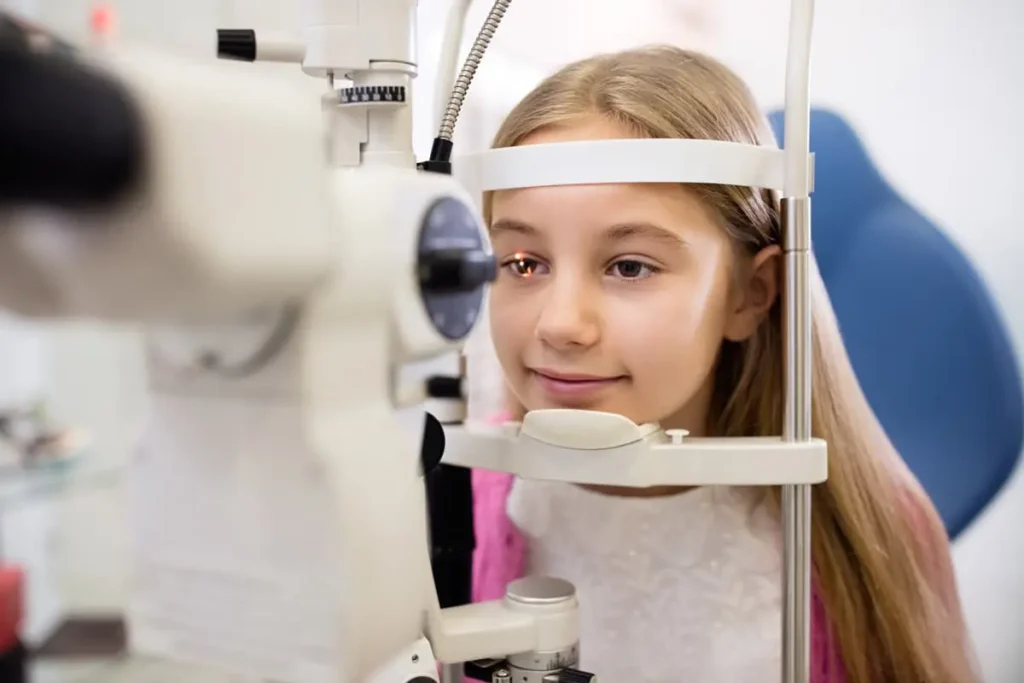
As your child gets ready for their first comprehensive eye examination, you may wonder what this experience involves.
Many parents picture a quick check-up involving reading letters from a chart, having a light shone into their eyes, and either receiving a prescription for glasses or reassurance that “glasses aren’t required.” While such a basic evaluation might be adequate for a simple vision check, it overlooks the complex ways in which children use their eyesight for activities like reading, writing, learning, and sustaining focus.
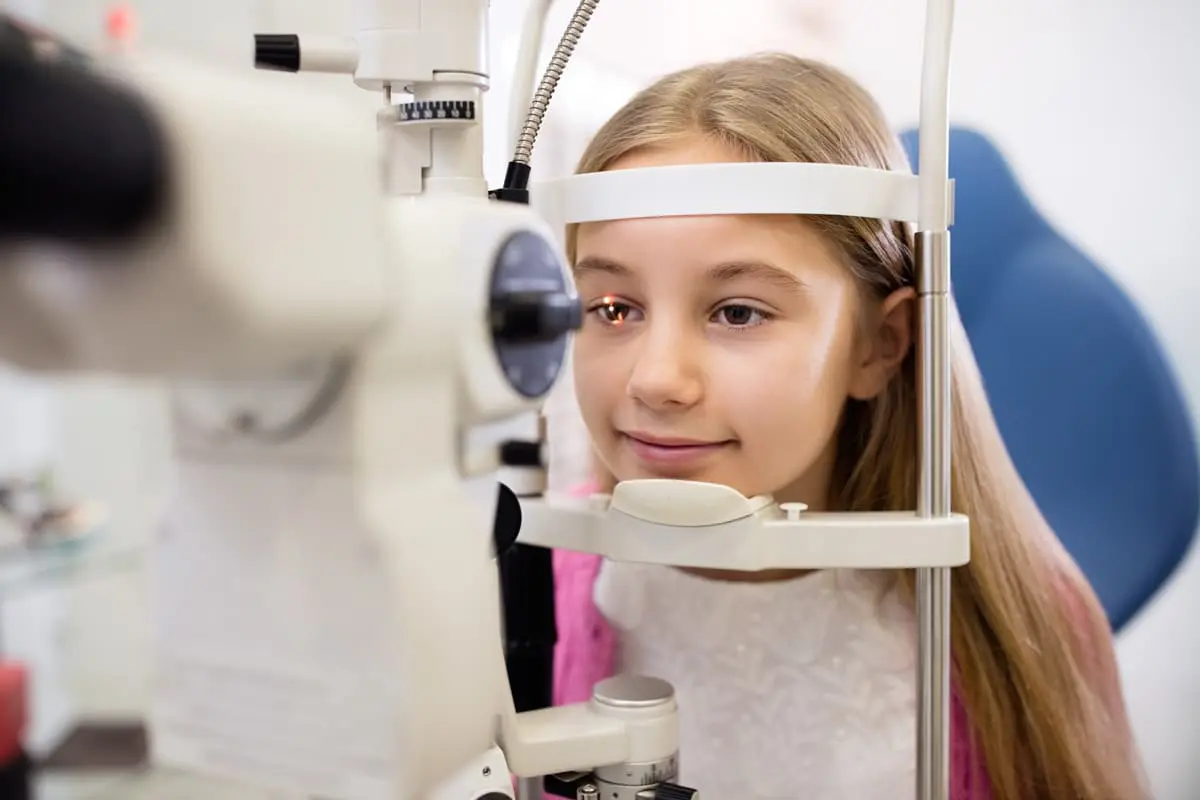
At Eyes by Design in Kincumber, we conduct children’s vision assessments that are far more detailed.
My focus extends beyond determining if your child has clear vision; I also evaluate the functionality of their visual system. This assessment includes examining how the eyes focus, coordinate, track across a page, maintain stability under stress, and whether visual processing skills are affecting their reading or academic achievements. If your child’s midyear report raises concerns about concentration or reading abilities, this assessment often represents a logical next step.
What Steps Can You Take to Make Your Child’s Eye Test More Comfortable?
It is completely normal for children to feel anxious when visiting an optometry office for the first time.
To help alleviate their apprehension, I take the time to slow down the appointment and interact with the child. I adjust the chair to suit their height, engage in conversation about their day, and foster a relaxed environment that feels inviting rather than clinical.
The assessment is not something I impose on the child; it is a collaborative experience.
This collaborative approach is crucial. Children can offer valuable insights through their comments, reactions, movements, fatigue levels, and confidence during tasks. If a child seems uncomfortable, avoids specific activities, or suddenly loses confidence, they may be indicating something significant.
I encourage parents to stay in the room during the assessment, and I prefer it this way. When parents are present, they can see what I see, enhancing the transparency of the findings. Having both parents there also reduces the burden on one parent to remember all the important details to discuss with the other.
How Can You Prepare for a Meaningful Conversation Before Eye Testing Begins?
Before initiating any testing, I prioritise a thorough discussion.
I seek to understand the entire context—not just whether your child can see the board. I inquire about their reading habits, spelling, handwriting, headaches, eye rubbing, concentration concerns, after-school fatigue, screen time, confidence levels, homework behaviours, and feedback from teachers.
I also explore their developmental history. Were key milestones met on schedule? Is there a history of middle ear infections or surgeries? Are their fine and gross motor skills developing appropriately? Have they had previous eye exams with any noted concerns or recommended treatments? Is there a family history of conditions such as lazy eye, high prescriptions, myopia, dyslexia, ADHD, migraines, or binocular vision issues?
This is not just a checklist; it guides me in determining where to focus my clinical examination.
For example, a child who struggles with close tasks but excels outdoors or in sports may be experiencing a visual load issue. In contrast, a child who can read comfortably for a short period but then becomes overwhelmed may have difficulties with focusing or binocular vision. A child who has trouble copying from the board might experience challenges with tracking, focus flexibility, or visual memory.
Children often articulate their symptoms in their own words. They might say, “the words move,” “the page gets blurry,” “I feel tired,” “I dislike reading,” “my eyes are sore,” or “I lose my place.” Even when a child finds it difficult to explain what they are experiencing, they can still provide us with valuable insights.
Which Key Areas Are Evaluated During a Children’s Vision Assessment?
Every child is different, so the assessment process may vary. Generally, I evaluate several essential areas.
Visual Acuity: Measuring Clarity of Vision for Each Eye
We begin by assessing how clearly each eye can see at both distance and near range. Depending on your child’s age, I may use letters, numbers, pictures, or matching targets. Each eye is tested individually, followed by a combined assessment.
This approach allows us to determine if one eye has better vision than the other, whether your child requires a prescription, and if there are signs of amblyopia, commonly referred to as lazy eye. Notably, a child can compensate quite well with one eye doing most of the work, which is why individual testing for each eye is crucial.
Children do not need to recognise letters for an effective eye test. For younger children, I can utilise picture charts, matching games, and objective assessments. A particularly effective method is retinoscopy, which enables me to estimate a child’s prescription by shining a light into the eye and observing the reflex as various lenses are introduced. The child simply gazes at a target without needing to respond with “one or two” or read letters. We also incorporate instrument-based measurements when appropriate.
Understanding the Prescription and Focusing Requirements
A prescription involves more than just clarity.
In children, I also evaluate how hard their focusing system needs to work. Some children achieve clarity momentarily but only by exerting excessive effort. This strain can lead to fatigue, particularly during reading, writing, and screen time.
I assess whether the child can focus accurately, shift focus between distances, and maintain clear vision during close-up tasks. Parents may notice a short attention span, yet the underlying issue could be visual fatigue.
Binocular Vision: Assessing Coordination Between Both Eyes
Binocular vision plays a vital role in a child’s vision assessment.
Effective reading requires both eyes to focus on the same point, maintain consistent focus at the same distance, and create a single, stable image continually, not just for brief moments.
I evaluate how well the eyes converge for nearby tasks, the stability of that convergence, the effort required, and how quickly the system recovers under stress.
If the eyes do not work together effectively, a child may experience blurriness, double vision, headaches, moving text, eye strain, or difficulty concentrating on close tasks. Binocular vision issues are often overlooked in standard eye tests that only assess clarity on a chart. This aspect is explored further in discussions on binocular vision dysfunction in children.
Evaluating Eye Tracking: Movement Across Text
Effective reading requires precise eye movements. The eyes perform a series of rapid jumps and then pause briefly to absorb information. At the end of a line, they must accurately jump to the beginning of the next line.
If these movements lack accuracy, reading efficiency decreases. A child may skip words, overlook lines, repeat lines, lose their place, rely heavily on a finger for tracking, or seem to guess words. I assess both smooth tracking and rapid eye jumps.
Assessing Depth Perception, Colour Vision, and Overall Eye Health
Depth perception indicates how well both eyes work together to provide the brain with a three-dimensional view of the environment. This ability is crucial for activities such as sports, coordination, navigating stairs, and estimating distances.
I also evaluate colour vision. Colour vision deficiencies are more common among boys and can often go unnoticed for years. While this condition typically does not hinder a child’s learning, it may impact their ability to interpret colour-coded materials in the classroom.
A thorough children’s vision assessment includes checking overall eye health. I examine the front structures of the eye, the internal components, the retina, and the optic nerve to ensure there are no signs that require further examination or referral.
Investigating Visual Processing Skills
When necessary, particularly if there are concerns related to reading, writing, copying, or academic performance, I also assess visual processing skills.
These skills involve the brain’s ability to interpret and organise visual information. Depending on the child’s age and specific concerns, this assessment may cover visual discrimination, visual memory, visual sequential memory, figure-ground skills, and other processing tasks.
A child may have clear vision yet still face challenges with visual processing.
How Is the Assessment Process Adapted for Younger Children?
For preschoolers, the appointment tends to be more flexible.
A three or four-year-old is not expected to maintain the same level of stillness as an older child. I tailor the assessment to suit the child’s age, attention span, and comfort level. We may incorporate pictures, matching games, lights, simple targets, and objective techniques that do not rely on verbal responses.
The primary goal at this stage is to establish a baseline, identify significant prescriptions, check for eye turns, assess the risk of amblyopia, and ensure visual development is progressing as expected.
What Should You Anticipate at the Conclusion of the Appointment?
The explanation provided at the end of the appointment is one of the most critical aspects of the visit.
I want parents to leave with a clear understanding of the prescription or recommendations. It’s essential for them to grasp what I discovered, its significance, and what the next steps entail.
I will clarify whether your child’s vision is developing as expected, whether glasses are necessary, whether binocular vision or focusing issues are present, and if any further evaluations or treatments are recommended.
Whenever possible, I demonstrate my findings during the appointment. For instance, if a child’s eyes struggle to converge, I can illustrate that. If a trial lens improves comfort or fluency, parents can often witness the enhancement firsthand.

What Important Information Should You Have If Your Child Needs Glasses or Vision Therapy?
If your child requires glasses, I will provide a detailed explanation of the prescription and advise when they should be worn. Some children need glasses all the time, others only at school, and some primarily for reading or close work. Certain prescriptions are designed mainly to alleviate visual strain rather than solely enhance clarity.
Vision therapy may be recommended if glasses alone do not fully address the issues, particularly for specific binocular vision, focusing, or eye movement challenges.
Vision therapy is a structured program aimed at enhancing the coordination between the eyes and the brain. It requires commitment and is recommended only when the findings indicate its necessity. It is not suitable for every child and should not be considered a universal solution for learning difficulties.
What Should You Consider If No Significant Issues Are Identified During the Assessment?
Sometimes, the assessment may indicate that vision is not the primary concern. This information is still valuable.
If vision is not significantly contributing to the issues, parents can confidently explore other avenues. Depending on the child’s symptoms, this may involve consulting a speech pathologist, occupational therapist, educational psychologist, general practitioner, or pediatrician.
The goal is not to attribute every challenge to vision but to conduct a thorough assessment to ensure any vision-related concerns are either addressed or ruled out.
Frequently Asked Questions About Children’s Vision Assessments
How Long Does a Children’s Eye Test at Eyes by Design Typically Last?
A comprehensive children’s vision assessment usually lasts around 45 minutes. This duration includes both testing and time at the end to discuss the findings with parents.
At What Age Should My Child Have Their First Eye Examination?
A first comprehensive assessment is generally recommended by the age of three or earlier if concerns arise. Children do not need to recognise letters to participate in testing.
Is a Referral Required for the Appointment?
No referral is necessary. Parents can directly book an appointment with Eyes by Design.
Should Both Parents Attend the Appointment?
If possible, having both parents present is beneficial, especially when the appointment addresses school, reading, or learning challenges. This ensures both parents receive the findings and recommendations directly.
Will the Assessment Be Uncomfortable for My Child?
No, a children’s vision assessment is completely painless. Most of the appointment involves looking at targets, answering simple questions, following lights or pictures, and completing age-appropriate visual tasks.
Is It Time to Arrange Your Child’s Vision Assessment?
If your child is finding it difficult with reading, concentration, headaches, schoolwork, or visual comfort, a comprehensive children’s vision assessment is an excellent first step.
At Eyes by Design in Kincumber, we evaluate much more than just whether your child can see the board. We examine how their vision supports the daily activities they engage in—reading, writing, copying, learning, participating in sports, and playing.
Contact Eyes by Design at 4369 8169 or book your appointment online through our website.
Original Article First Published At: What to Expect During a Children’s Vision Assessment at Eyes by Design
The Article: Children’s Vision Assessment: What to Expect at Eyes by Design first appeared on https://writebuff.com
The Article Children’s Vision Assessment at Eyes by Design: What to Know Was Found On https://limitsofstrategy.com
References:
Children’s Vision Assessment at Eyes by Design: What to Know
Children’s Vision Assessment: Essential Insights from Eyes by Design